 Bayu Permadi
Removing Release Bottlenecks in a Fast-Moving Digital Era
Why Slow Release Cycles Hold Back Business Growth
In a digital landscape that changes this quickly, adopting a modern development approach such as trunk-based development is an important way to address slow, inefficient application releases. Many mid-sized and large companies are still working in traditional development cycles, where code is merged only weekly or even monthly. This conventional approach often creates serious operational friction: engineers spend days resolving conflicting code changes before an application can be deployed. As a result, product launches slip, user feedback arrives late, and valuable market opportunities are lost to competitors that move more nimbly. Technology decision-makers such as CTOs and IT Managers should recognize that slow release cycles directly reduce customer satisfaction and increase the company’s operating costs.
Trunk-Based Development as a New Way of Working
To address these challenges, trunk-based development has become an established standard among high-performing modern software teams. In this approach, all developers integrate their code changes into a single main branch, called the “trunk,” consistently and frequently, often several times a day. This strategy removes the reliance on long-lived branches, which have long been a primary source of system integration problems. With trunk-based development, your IT team can catch bugs early, keep the codebase consistent across departments, and ensure the application is always ready to release whenever the business needs it. This approach not only speeds up software development but also builds a solid foundation for greater flexibility and resilience in the global market.
How Trunk-Based Development Changes the Way Your Engineering Team Works
The Technical Anatomy of a Workflow Without Long-Lived Branches
Technically, implementing this branching strategy requires a fundamental change in how developers manage code in the repository day to day. Instead of creating separate feature branches that last for weeks, developers work on very short-lived branches that are typically merged back into the main trunk in less than 24 hours. Code review happens quickly through small pull requests that do not overload reviewers, so work keeps flowing without exhausting technical bureaucracy. To make sure half-finished features do not affect end users in production, teams rely on an advanced technique known as feature flags, or feature toggles. With this method, new code can be safely integrated into the main system without being activated publicly right away, giving business teams full control over the most suitable time to launch.
A Natural Fit with Continuous Integration (CI)
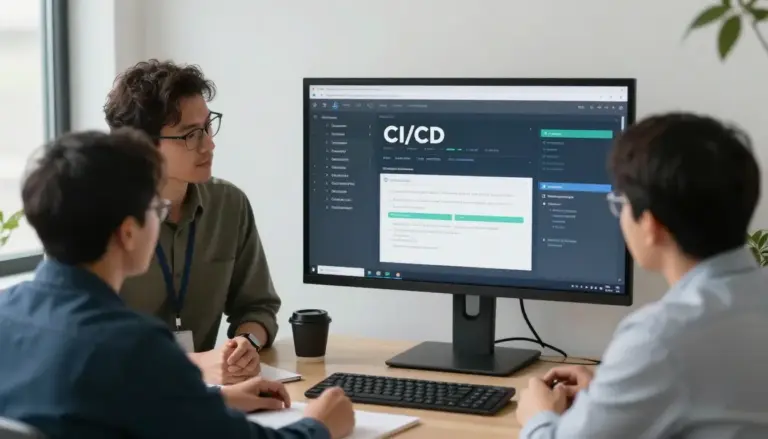
Successful adoption of trunk-based development depends heavily on strong test automation through a Continuous Integration (CI) system. Each time a developer pushes code to the main branch, the CI system automatically runs a series of automated tests to verify that the change does not break existing functionality. This creates an instant feedback loop in which even the smallest error can be detected and fixed within minutes, before it affects the wider application. With automated validation running continuously, the engineering team’s confidence in deploying to production increases considerably. The combination of a disciplined branching strategy and CI automation is the main driver for raising your company’s release velocity to a level it has not reached before.
The Real Impact on Operational Efficiency and Business Scalability
Reducing Merge Conflict Risk and Strengthening Application Security
For decision-makers at the management level, adopting trunk-based development means reducing operational risks that can harm system stability and the company’s reputation. When code is integrated in small, constant increments, the likelihood of massive merge conflicts drops to close to zero. This also benefits information security, because security patches and fixes for critical vulnerabilities can be applied directly to the main branch and rolled out across the system within hours. Your IT team no longer has to backport patches across multiple release branches, a process that is prone to human error and security oversights. Compliance audits and release management also become far more transparent and predictable, giving business stakeholders greater peace of mind.
Optimizing Infrastructure and Reducing Cloud Costs
From a financial perspective, the efficiency gained from this modern development approach translates directly into meaningful savings on IT infrastructure budgets. With fast and stable release cycles, the need for complex, expensive staging environments to maintain multiple release versions can be reduced substantially. Cloud infrastructure can be optimized to support dynamic, automated testing pipelines that run only when needed, reducing the waste of idle compute resources. As a trusted infrastructure solutions provider, Pandawa Cloud .Net understands that this cost efficiency is essential to maximizing the ROI of your technology investments. By aligning a high-performance cloud architecture with an efficient deployment methodology, your company can allocate its IT budget more strategically toward future product innovation.
Practical Steps to Adopt a Modern Branching Strategy with a Trusted Partner
Cultural and Technical Migration Stages in Your IT Organization
Moving to trunk-based development is not simply a change of tools. It is a cultural shift that requires commitment and a solid understanding across the whole engineering team. The recommended first step is to strengthen your automated testing infrastructure so that every new code integration is rigorously validated without slow manual intervention. Next, management should provide training so developers become used to writing code in small pieces that can be integrated regularly. Begin the transition with a single pilot project that carries low risk but high value, to demonstrate the effectiveness of the new method before rolling it out across the IT department. Consistent leadership support and the right tooling will help the migration proceed smoothly, with minimal impact on day-to-day operations.
Accelerating Your Deployment Pipeline with Pandawa Cloud .Net
Building a resilient DevOps ecosystem to support faster releases requires specialized expertise and reliable, highly scalable cloud infrastructure. Pandawa Cloud .Net is ready to be your strategic partner in designing, optimizing, and managing Continuous Integration and Continuous Deployment (CI/CD) pipelines tailored to your business’s specific needs. We provide cloud infrastructure solutions built to support high performance, stability, and strong security while your automated tests run. With support from our expert team, your company can adopt this modern deployment approach with confidence, without worrying about the complexity of managing the infrastructure behind the scenes. Contact our consulting team today to discuss how we can help accelerate your digital transformation and take your application release speed to the next level.