 Bayu Permadi
Protecting Business Continuity from the Risk of Failed Releases
The Reality of Deployment Failures in the Digital Era
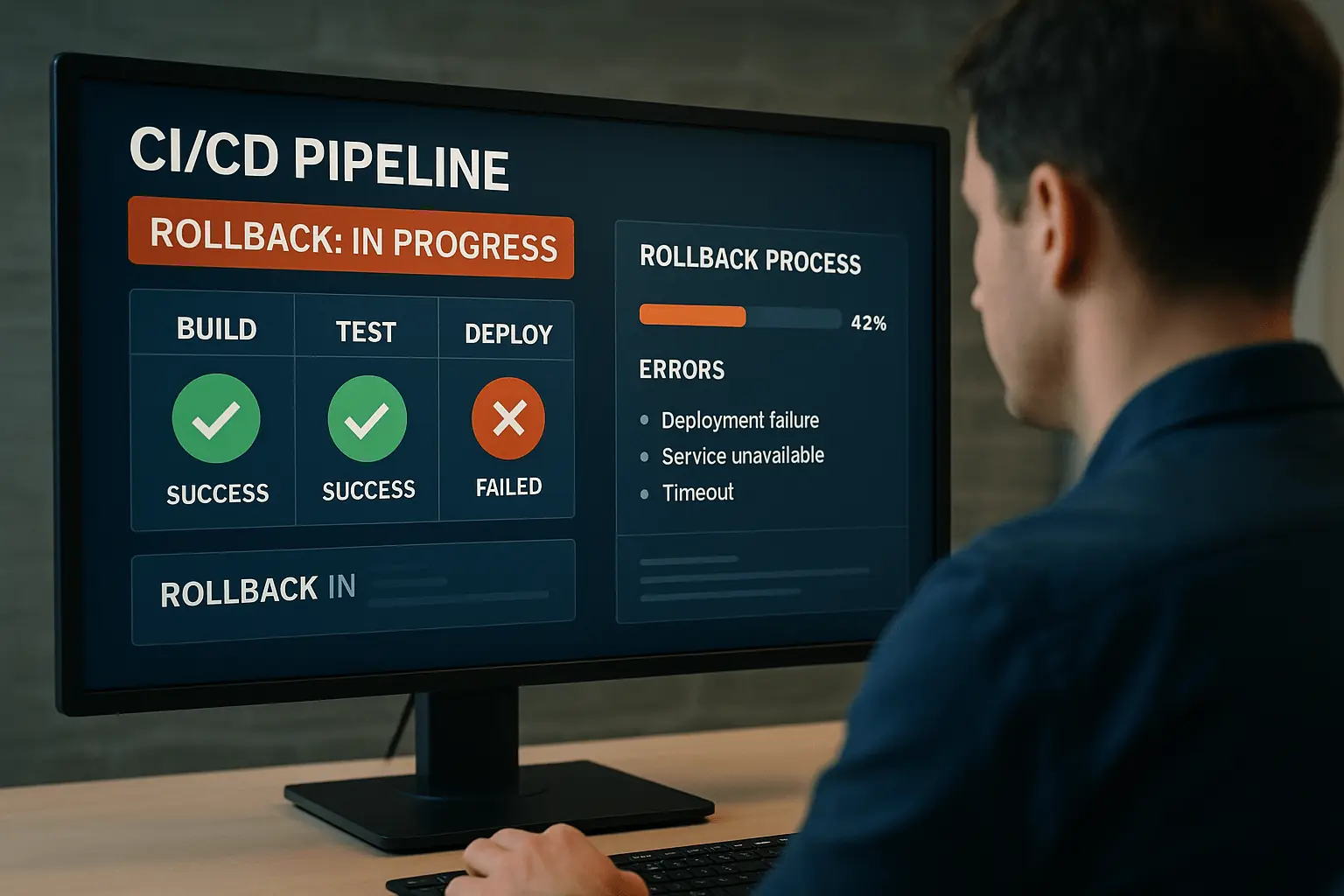
Automated rollback deployment has become a critical pillar of operational stability for modern digital companies that need services to stay available around the clock. Users expect responsive applications with minimal disruption, and every new feature release carries an inherent risk that cannot be ignored. A failed deployment is not merely an internal technical issue for the software engineering team. It is a direct threat to brand reputation, customer satisfaction, and company revenue. When a system goes down after an update, financial losses accumulate in real time, while the IT team has to work under heavy pressure to find the root cause. A reactive approach to release failures is therefore no longer adequate if you want to keep the business healthy.
Why Manual Response Is No Longer Enough
Relying on manual intervention to restore a system after a failed deployment is a high-risk strategy that often extends downtime significantly. In a crisis, even the most experienced engineers are prone to procedural mistakes when running rollback commands by hand. Slow coordination, hunting for outdated documentation of the previous release, and lengthy log analysis are the main reasons Mean Time to Resolution (MTTR) grows. Without an automated response, restoring the previous state can take hours, with a knock-on effect across company operations. The best strategic decision to mitigate this risk is to put an automated safeguard in place that can act within seconds, without direct human involvement.
Turning an Obstacle into a Competitive Advantage
Understanding How Automated Rollback Deployment Works
In a modern DevOps ecosystem, automation is not only about how quickly new code can be pushed to production. It is also about how quickly you can recover when something goes wrong. An automated rollback deployment mechanism works by integrating real-time application performance monitoring (APM) with the Continuous Integration and Continuous Delivery (CI/CD) pipeline. When the newest application version shows a spike in error rate, abnormal latency, or database connection failures, the monitoring system immediately sends a trigger signal to the deployment server. According to metrics gathered by DevOps Research and Assessment (DORA), organizations with mature automated recovery capabilities can limit the impact of defective releases almost instantly. The system automatically routes user traffic back to the previous stable version, isolating the error before it reaches the entire user base.
Financial and Operational Impact on the Business
From an investment and efficiency perspective, adopting a reliable automated rollback deployment system has a direct positive effect on operating costs. A sharp reduction in downtime means protecting high-value transactions that could otherwise be lost when customers cannot reach your system. Your engineers also no longer need to stay up late monitoring post-deployment or firefighting under intense stress. Team productivity improves considerably because they can focus on product innovation and new features instead of being caught in a cycle of emergency bug fixes. Customer trust is also preserved, because customers barely notice any disruption, even when a technical failure occurs behind the scenes during an update.
Building System Reliability Without Limits
Key Pillars of a Resilient Rollback Architecture
To build a dependable automated recovery system, a company needs to pay attention to several well-integrated architectural elements. The success of an automated rollback deployment architecture depends heavily on defining application health checks that are accurate and sensitive to performance anomalies. Database state management must also be planned carefully so that the schema stays compatible with both the new and the previous application versions (backward compatibility). Deployment strategies such as blue-green deployment or canary releases are strongly recommended to limit the blast radius of a failure before automated rollback takes full effect. By shifting traffic gradually, the risk of a large-scale systemic failure can be greatly reduced, giving the system a safe margin to recover on its own.
Fostering a Culture of Innovation Without Fear
An indirect but valuable benefit of automated mitigation is a healthier culture of innovation within your engineering team. When developers know the system has a strong automated safety net, their fear of release failures drops significantly. They become more willing to experiment with new technology and to shorten the cycle for bringing features to market, which gives your company an advantage over slower competitors. Adapting quickly to market needs is key to success in modern business, and automated rollback gives your team the confidence to move quickly without sacrificing service stability. Over time, system stability combined with fast innovation strengthens your company’s market position over the long term.
Practical Steps Toward a Self-Healing System
Start the Transformation with Pandawa Cloud .Net
Integrating automated recovery into infrastructure that is already running requires deep expertise and a thorough understanding of cloud architecture patterns. As your strategic partner, Pandawa Cloud .Net can help you design an automated rollback deployment strategy tailored to the unique characteristics of your business and application architecture. We identify gaps in your current CI/CD pipeline, define relevant monitoring metrics, and configure smooth automated rollback scenarios that minimize manual intervention. With support from our experienced team, the transition to a self-healing system can proceed safely without disrupting your ongoing business operations.
Schedule a Strategic Consultation Today
The first step toward a resilient digital transformation is a decision, made today, to protect every application release from the risk of failure. Do not let your next failed deployment put your business reputation at risk and erode the customer satisfaction you have worked hard to build. Contact the Pandawa Cloud .Net consulting team to discuss how we can strengthen the resilience of your cloud infrastructure through smart, reliable automation. We are ready to help you design a technology roadmap that is technically sound, delivers real business value, and gives your management team greater peace of mind.