 Bayu Permadi
Navigating Cloud Efficiency for Business Leaders
Why Is Cloud Efficiency a Top Priority Right Now?
In a fast-moving digital transformation era, choosing the right cloud architecture is a critical decision that directly affects a company’s profitability and operational agility. The serverless vs container business question is no longer just a technical discussion among engineers. It is a strategic decision that determines how quickly your product reaches the market. Many companies end up with ballooning infrastructure costs because they chose the wrong architectural foundation at the outset. Understanding the fundamental differences between the two helps decision-makers avoid unnecessary cloud spend. Those savings can then be redirected toward product innovation that has a more direct impact on customer retention.
The Classic Dilemma: Control Versus Operational Simplicity
Every technology leader has faced the trade-off between holding full control over their systems and focusing entirely on developing business features. Managing infrastructure yourself offers unlimited flexibility, but it consumes the time, energy, and focus of your valuable IT team. Handing all management over to a cloud provider, on the other hand, promises convenience, but it often raises concerns about dependence on a single vendor. Finding the balance between these two poles is the key to running lean operations that stay agile in a competitive market. This is why it is important to objectively assess your internal team’s capabilities before deciding which technology direction to take.
Understanding the Characteristics and Business Impact of Both Architectures
Key Characteristics in the Serverless vs Container Business Decision
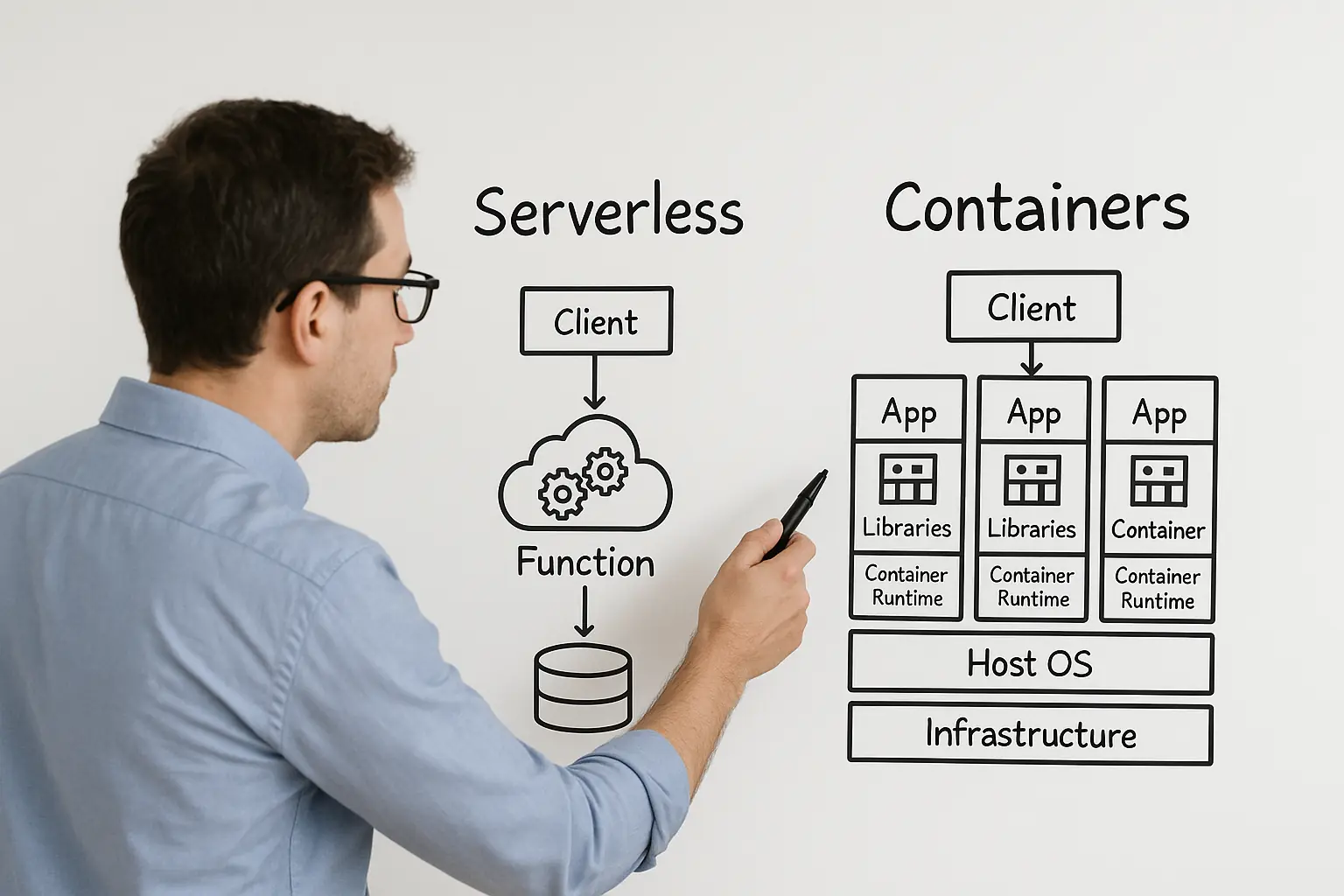
To make the right decision, we need to look past the technical jargon and focus on how each architecture works within your business ecosystem. A closer look at serverless vs container business trade-offs shows that containers offer a consistent, isolated environment in which you control the entire operating system, runtime, and application dependencies yourself. Serverless, by contrast, removes the need to think about physical or virtual servers at all, because the cloud provider allocates resources dynamically as requests come in. This fundamental difference shapes how your team works, your monthly cost structure, and how quickly you can release software updates to end users.
Dynamic Workloads: Where Serverless Excels
Serverless works especially well for unpredictable workloads, sharp spikes at specific times, or periods of prolonged inactivity. Its pay-as-you-go model means you pay only for the milliseconds of compute actually used while your application code runs. When no one is using the service, your infrastructure cost drops to zero automatically, with no manual intervention from your DevOps team. This delivers significant cost efficiency for companies with fluctuating traffic profiles, as well as for new projects still in the market validation stage.
Full Control Without Limits: Where Containers Excel
If your application needs long execution times, continuous data-intensive processing, or must meet strict regulatory requirements that prohibit storing data in shared environments, containers are the better choice. Through standardization supported by global organizations such as the Cloud Native Computing Foundation (CNCF), container technology allows true portability across clouds without significant technical barriers. You have the freedom to tune system performance down to the kernel level, configure internal networking in detail, and manage high-performance persistent storage. Containers provide consistent, predictable performance for core business applications that run around the clock.
Aligning Technology Choices with Your Company’s Strategic Vision
When Should Your Business Choose Serverless?
Consider serverless if your company’s main priority right now is shortening time-to-market for a new product or an experimental feature under test. In the serverless vs container business comparison, serverless is particularly advantageous when you do not want your developers burdened with server management, operating system security patches, or auto-scaling configuration. Its event-driven architecture suits background tasks such as image processing, webhooks, simple data pipelines, or micro APIs that handle requests sporadically. By minimizing infrastructure management overhead, your engineering team can put its full energy into writing code that creates direct business value.
When Are Containers the Better Choice?
Containers remain the strongest option when you are modernizing a complex legacy application that is difficult to break into small functions. Converting a large monolithic architecture directly to serverless often involves very expensive refactoring and a high risk of system failure. Containers let you package your existing application with minimal changes, then run it in the cloud with far better reliability through an orchestration platform such as Kubernetes. They are also a good fit for companies pursuing a multi-cloud strategy to avoid dependence on a single cloud provider.
TCO Analysis: Comparing the Real Costs of Both
When calculating Total Cost of Ownership (TCO), decision-makers often look only at the monthly cloud bill and overlook hidden staffing costs. Managing large-scale container clusters requires senior DevOps specialists, who command high salaries in a very competitive market. Serverless cuts these operational staffing costs significantly, because responsibility for infrastructure maintenance shifts entirely to your chosen cloud provider. However, if your application handles very high, constant traffic every second, the cumulative cost of serverless execution can exceed the cost of renting fixed container servers. A thorough analysis of your application’s traffic characteristics is therefore essential before making this financial decision.
Taking the First Step Toward the Right Infrastructure Transformation
Practical Steps for Evaluating Your Application Portfolio
A sensible first step is not to migrate everything at once, but to audit your application portfolio and identify which parts benefit most from each architecture. Start with a small pilot project, such as moving a rarely used reporting module to serverless, or packaging one standalone service into a container. Review the performance, team responsiveness, and costs that the pilot produces over the first one to three months. The final decision on serverless vs container business is not about picking one absolute winner. It is about combining the strengths of both in a hybrid architecture that supports your business growth.
Partnering with Pandawa Cloud .Net for Optimal Results
Designing an efficient cloud architecture takes deep expertise, extensive hands-on experience, and an objective view of where global technology is heading. As your trusted strategic advisor, Pandawa Cloud .Net is ready to support your company’s digital transformation journey, from the initial assessment through to production implementation. We help analyze your unique business needs thoroughly, recommend the most cost-effective architecture, and keep the transition running smoothly without disrupting day-to-day operations. With the right partner, you can reduce the risk of a failed migration and make sure every technology investment delivers the maximum return in business value.