 Bayu Permadi
Attention
The Reality of Cloud Budget Waste Today
Many mid-sized and enterprise companies move to cloud infrastructure expecting a significant cut in IT operating costs. In practice, the result is often the opposite: monthly bills keep climbing without a proportional improvement in business performance. This is why a clear understanding of rightsizing vs auto-scaling cloud matters so much for IT decision-makers. According to industry reports from the FinOps Foundation, the average company wastes roughly thirty percent of its total cloud budget on inefficient resource allocation. This is not merely a technical issue. It is a financial leak that directly erodes your company’s profitability and margins.
The Classic Dilemma: Cut Capacity or Manage Elasticity?
CTOs and IT Managers often face a familiar dilemma when pressed to improve infrastructure cost efficiency. On one side, there is pressure to cut server capacity quickly and reduce monthly spending right away. On the other, there is a well-founded concern that reducing capacity too hastily can compromise system stability and the end-user experience when traffic spikes. This dilemma calls for a more analytical approach than arbitrary budget cuts. Choosing the right strategy requires a thorough understanding of how your applications’ workloads behave over time, so that every decision rests on solid data.
Interest
Rightsizing from a FinOps Perspective
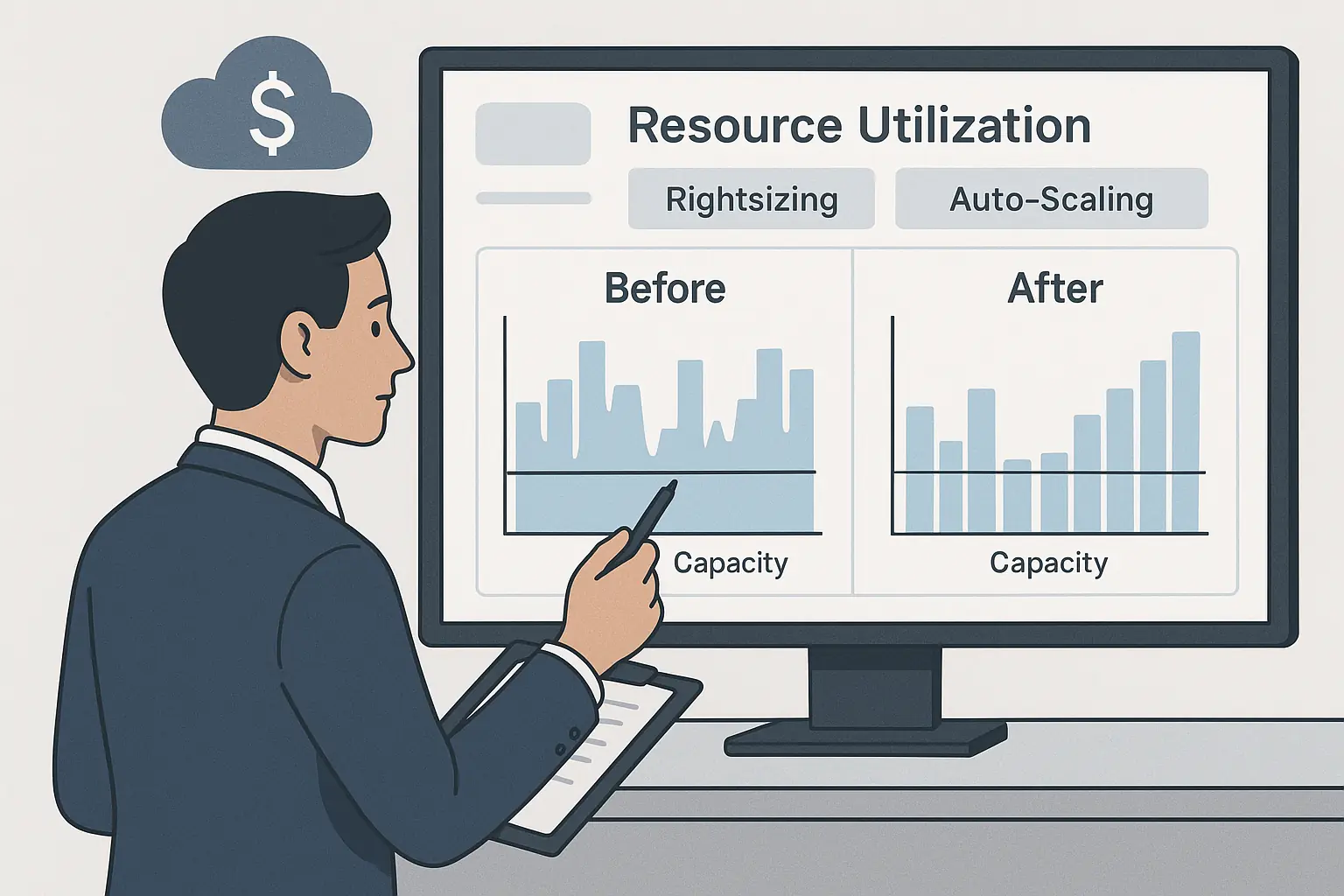
Rightsizing is a systematic process of analyzing historical resource usage trends and adjusting server sizes or storage capacity to match actual needs. It is a core pillar of the FinOps discipline, which aims to ensure that every rupiah spent on cloud delivers maximum business value. When comparing rightsizing vs auto-scaling cloud for long-term cost optimization, rightsizing serves as the foundational step. By identifying instances that are over-provisioned or even idle, IT teams can take corrective action right away, either by downsizing machine specifications or by consolidating workloads. This delivers an immediate, predictable reduction in costs and sets a much healthier infrastructure baseline for the company.
Understanding Auto-Scaling to Protect Service Availability
Unlike the static approach, auto-scaling works dynamically, automatically adjusting the number of active instances based on real-time metrics such as CPU usage, memory, or request volume. This strategy is designed to handle unpredictable workload fluctuations without manual intervention from the operations team. However, relying on auto-scaling alone, without rightsizing first, can become a costly financial trap. If the base instances are already oversized from the start, scaling out simply multiplies that inefficiency as traffic grows. Auto-scaling should therefore be positioned as an elasticity mechanism that protects service availability, not as the primary fix for waste in your core infrastructure.
Desire
Rightsizing vs Auto-Scaling Cloud: Which Is Right for Your Business?
To decide which strategy fits best, a company needs to analyze the specific characteristics of each workload it runs. For workloads that are stable, consistent, and predictable, such as internal ERP systems or core databases, rightsizing is clearly the most efficient choice. For customer-facing applications with highly variable traffic, such as e-commerce platforms or streaming services, auto-scaling offers the flexibility needed to keep the system reliable. The comparison of rightsizing vs auto-scaling cloud is not about picking one and discarding the other. It is about placing each solution in the business scenario where it is most relevant, so you can achieve the greatest efficiency.
The Hybrid Approach: The Best Way to Improve Cost Optimization
The best practice recommended by Cloud Financial Analysts is a hybrid approach that combines both strategies. A tactical integration of rightsizing vs auto-scaling cloud gives the company a lean, cost-effective infrastructure baseline through rightsizing, while a carefully tuned auto-scaling configuration ensures it is ready for traffic surges. By combining the two, companies can achieve optimal cloud efficiency without sacrificing system performance during peak hours. This integrated approach does more than reduce day-to-day operating costs. It also creates an IT architecture that is resilient, agile, and adaptable to the changing needs of the modern business.
Action
Taking the Next Step with Pandawa Cloud .Net
Implementing a comprehensive cloud cost optimization strategy requires deep expertise, advanced monitoring tools, and a solid understanding of local regulations. The decision between rightsizing vs auto-scaling cloud does not have to be something your internal team works through alone while also managing core business growth. Pandawa Cloud .Net is a strategic partner (a wise peer) ready to support your digital transformation and infrastructure efficiency journey. Our experts will help analyze your current cloud architecture, build a structured FinOps roadmap, and carry out optimization steps without disrupting your day-to-day business operations.
Let’s Discuss a Cloud Efficiency Solution That Fits Your Company’s Needs
We understand that every company has its own IT landscape and business goals, and that a one-size-fits-all solution rarely works. In a strategic consultation with the cloud architects at Pandawa Cloud .Net, you will receive an in-depth analysis of the cost savings that can be realized soon, without lowering service quality. Let’s work together to build a cloud infrastructure that is technically reliable, efficient, and a real contributor to your company’s long-term profitability. Contact us today to take the first step toward cloud management that is smarter, more transparent, and more valuable to your business.