 Bayu Permadi
Facing the New Reality of Cybersecurity in the Cloud Era
A New Digital Security Paradigm: Why the Traditional Perimeter Is Collapsing
Amid the massive acceleration of digital transformation, adopting a zero trust architecture for the cloud is no longer an optional extra but an absolute strategic necessity for every organization. Many technology leaders recognize that the traditional perimeter security model, which assumes that everything inside the internal network can be trusted, is no longer relevant for facing the modern threat landscape. When business infrastructure moves to the cloud, the physical boundaries of the conventional network disappear, leaving new security gaps that are easy for bad actors to exploit. Understanding how this concept works will help CTOs and IT managers protect their company’s most valuable digital assets from increasingly sophisticated threats. Resilient data security has become one of the main pillars that determine business continuity and reputation in the global market. Shifting your cybersecurity approach to a more proactive one is therefore the wisest step decision-makers can take today.
Cloud security today demands a more dynamic approach because employees now work from many locations on a variety of devices. According to global security landscape reports, most data breach incidents are rooted in compromised internal credentials with excessive access rights. By adopting the basic principle of “never trust, always verify,” your company can mitigate the risk of lateral movement, where an attacker who breaks through one point can easily take over the entire network. Moving to this architecture requires a shift in mindset, from focusing on protecting the outer gate to granular protection at every layer of data. This approach ensures that every data transaction and user access is strictly validated regardless of where the request comes from.
Understanding How Zero Trust Works in Depth
The Main Pillars of Implementing a Zero Trust Architecture in the Cloud
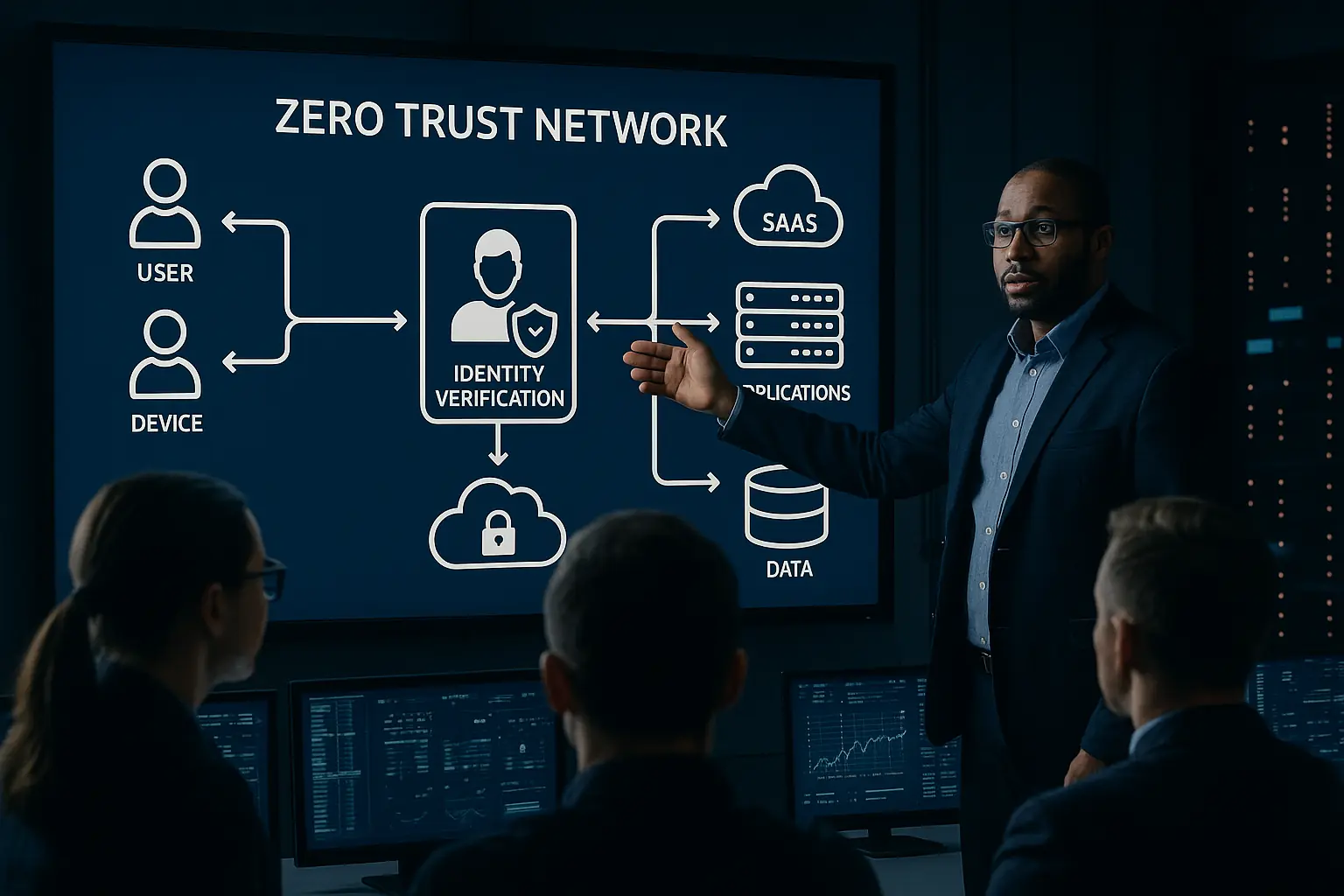
To implement a zero trust architecture for the cloud successfully, decision-makers need to understand the three main pillars that support it. The first pillar is explicit identity verification, which ensures that every user and device trying to access data must be validated in real time without exception. The second pillar is least privilege access, which limits user authority to only the resources they truly need to complete a specific task. The third pillar is assume breach, a proactive mindset that pushes IT teams to always be ready for the possibility that their defenses have already been compromised. Through a comprehensive understanding of these three pillars, a company can build a security framework that is dynamic and adaptive to evolving threats.
Applying these three pillars consistently will change how your IT infrastructure responds to every access request. The system no longer grants automatic trust based on a user’s physical location or IP address, but performs deep, continuous contextual evaluation. This evaluation includes assessing device health, the geographic location of the requester, and unusual access times to detect potential threats early. That way, your cybersecurity team can detect and isolate suspicious activity before it develops into a damaging incident. This tactical step gives management peace of mind that all digital operations run on a solid foundation.
Identity Access Management (IAM) as the Front Line
In a cloud ecosystem, identity now functions as the new perimeter, replacing the rigid traditional firewall. A strong Identity Access Management (IAM) implementation lets a company tightly control who can access sensitive data, when that access is granted, and from which device. Through multi-factor authentication (MFA) combined with AI-based behavioral analysis, the system can detect anomalous activity instantly. This significantly reduces the risk of data leaks caused by weak passwords or social engineering tactics targeting your employees. Disciplined IAM also simplifies compliance audits because every user activity is recorded accurately and cannot be tampered with.
Beyond restricting access, a modern IAM system also facilitates automatic periodic review of user privileges. This policy ensures that employees who have moved divisions or left the company no longer have access to the sensitive systems they previously managed. This is often overlooked by many organizations, yet abandoned accounts with high privileges are easy targets for hackers. By tidying up identity management, a company indirectly improves IT governance efficiency and reduces the workload on the administration team. This transformation is concrete proof that good cybersecurity goes hand in hand with day-to-day operational efficiency.
Network Segmentation: Limiting the Threat’s Room to Move
In addition to identity management, network segmentation, or micro-segmentation, plays a crucial role in limiting an attacker’s room to move if a cyber incident occurs. By dividing cloud infrastructure into small, logically isolated zones, a company can ensure that a compromise of one non-critical server will not spread to the main financial or operational databases. This segmentation approach ensures that all data traffic between segments goes through strict, automated security checks. As a result, an attacker’s ability to explore the internal network (lateral movement) can be pushed down to zero. This strategy is very effective for protecting legacy applications that do not yet fully support modern security protocols.
Implementing micro-segmentation in the cloud also gives development teams greater flexibility to innovate without sacrificing security. Teams can experiment in fully isolated testing environments without worrying that a configuration mistake will affect the live production environment. This flexibility is very important for companies that want to maintain their product release pace in a competitive market. In addition, network segmentation makes it easier to visualize data flows within the organization, giving a clearer picture of how digital assets interact with one another. With clear mapping, decisions about infrastructure upgrades can be made on accurate data.
Building Business Resilience Through Continuous Security
The Strategic Impact on Operational Efficiency and Regulatory Compliance
Integrating a zero trust architecture for the cloud into a company’s long-term technology strategy is not only about improving cyber resilience, but also about creating real business value. When a security system is designed modularly and based on identity, onboarding new employees or integrating third-party systems can be done much faster and more safely. Besides improving operational efficiency, this approach also makes it easier for companies to meet strict industry compliance standards such as GDPR, PCI-DSS, and local personal data protection regulations. These compliance standards require transparent audit evidence of how data access is managed and closely monitored. According to the official standard from NIST (National Institute of Standards and Technology), this framework provides a very strong foundation for modern regulatory compliance.
The ease of meeting these regulations gives your company a significant competitive advantage in the eyes of clients and global business partners. In an era where data privacy is a major consumer concern, brands that can show a real commitment to information security win market trust more easily. B2B partnerships often require strict cybersecurity assurances before a cooperation contract can be signed. With infrastructure that has already adopted these zero trust principles, security due diligence can be completed faster without major obstacles. This directly speeds up the sales cycle and opens up broader, higher-value business collaboration opportunities.
Reducing the Financial Risk of Data Breaches
The costs of a cybersecurity failure often go far beyond the direct financial loss; they also include the loss of a brand reputation built over many years. By applying a zero trust architecture for the cloud, your company can proactively minimize the financial impact of a potential data breach before it spreads widely. The ability to isolate threats within seconds ensures business operations keep running without significant downtime. Investment in such a comprehensive security system will ultimately be seen by shareholders as a very rational, strategic risk mitigation step that pays off in the long term. The savings from preventing a major incident are far higher than the cost of post-disaster recovery.
Besides avoiding large regulatory fines, early protection also safeguards the intellectual property and confidential data that give you a competitive edge in the market. When competitors suffer operational disruption from a ransomware attack, your company can keep serving customers reliably and without obstruction. This reliability strengthens your company’s market position as a partner that can be counted on in any condition. This operational resilience ultimately contributes directly to revenue stability and long-term business growth. Strategic decision-makers should therefore view cybersecurity as a business enabler, not just a cost center that burdens the budget.
Starting Your Cloud Security Transformation with Pandawa Cloud .Net
The First Step to Adopting Zero Trust with Pandawa Cloud .Net
Making the transition to this modern security model does take careful planning and a deep understanding of your current system architecture. This is where Pandawa Cloud .Net comes in as a strategic partner, ready to accompany your company through every phase of adopting a zero trust architecture for the cloud smoothly. We understand that every organization has unique challenges, so we do not offer a one-size-fits-all solution but a curated approach tailored to your business needs. Our team of experts will help identify critical assets, design strict access policies, and configure micro-segmentation without disrupting your team’s daily productivity. With the right guidance, the complexity of system migration can be broken down into tactical steps that are easy to manage.
Resilient cloud security is the best investment to ensure your business is ready to face future challenges with confidence. Do not let an undetected security gap hold back your growth momentum and damage the reputation you have worked hard to build. Discuss your company’s infrastructure challenges and cloud security needs with our senior consultants to define the most efficient tactical steps. Contact the Pandawa Cloud .Net team today to schedule an in-depth consultation and build a solid, adaptive cyber foundation for your sustainable business continuity. We are committed to being a trusted partner that keeps your digital assets safe at every step of your cyber transformation.