 Bayu Permadi
The Challenge of Modern Software Releases: The Gap Between Expectation and Reality
In today’s fast-moving digital environment, the demand for faster software releases has become a constant pressure on business decision-makers. CEOs, CTOs, and IT Managers are expected to deliver innovation faster, at higher quality, and at lower cost, all while keeping systems secure and stable. Yet the reality of traditional development and operations processes often cannot keep pace with these expectations, creating a significant performance gap. This gap is what keeps companies from staying competitive and responsive to constantly shifting market dynamics. To address this fundamental challenge, integrating AI in DevOps is no longer a futuristic experiment. It is an urgent strategic need for any organization that wants to lead the digital transformation.
Why Is the Traditional Approach No Longer Enough?
Traditional software development and operations, which often rely on manual processes and heavy human intervention, have reached their limit. Modern software architecture is dominated by microservices and third-party integrations, and this complexity leaves testing, monitoring, and deployment highly exposed to human error and inefficiency. Every new release risks introducing security vulnerabilities, bugs, or performance degradation, which leads to costly fixes and reputational damage. Moreover, market speed demands rapid product iteration and continuous adaptation to customer feedback, something slow, bureaucratic release cycles cannot accommodate. This is why a smarter, more proactive, and fully automated approach has become essential to maintaining a competitive edge and ensuring long-term business continuity.
Transforming the CI/CD Pipeline with Artificial Intelligence
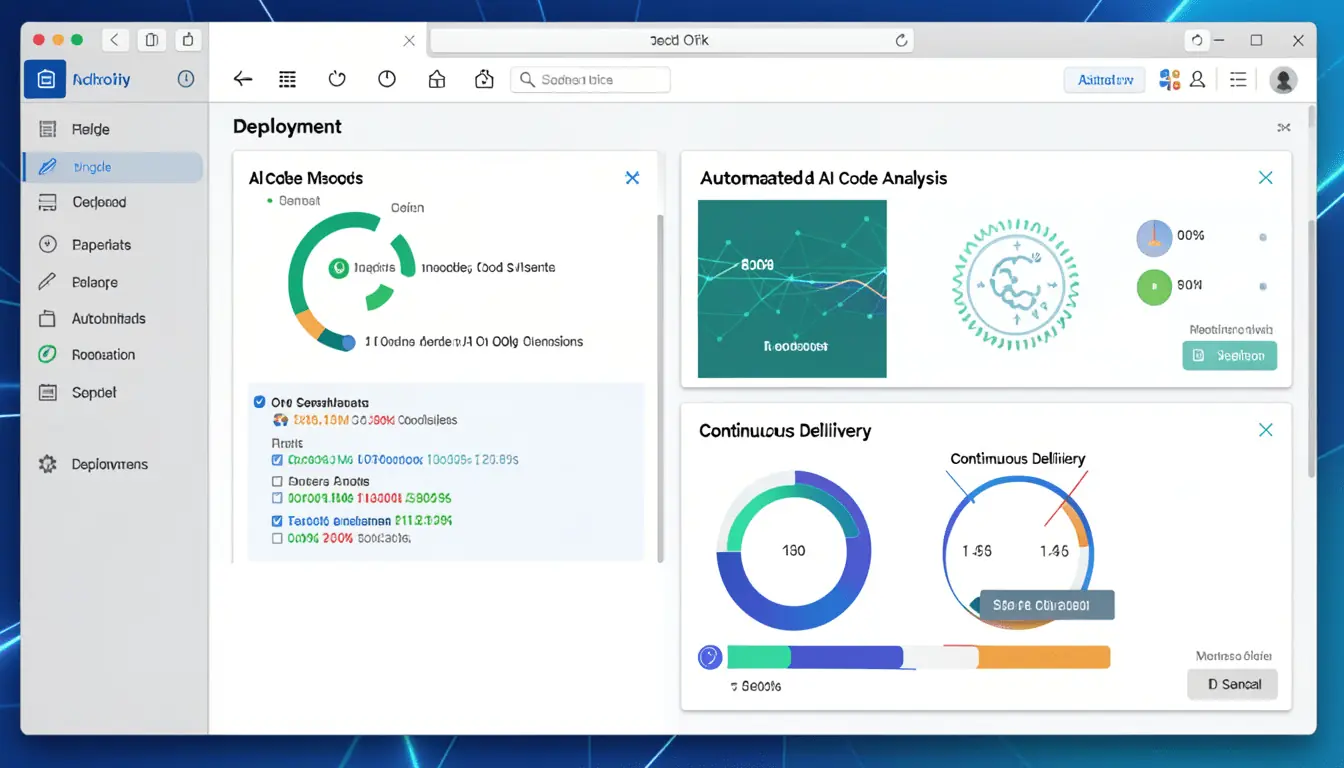
Integrating artificial intelligence (AI) into the Continuous Integration/Continuous Delivery (CI/CD) pipeline is a transformative step that lets companies move beyond the limits of traditional approaches. AI can analyze historical patterns in code, testing, and deployment logs to identify potential problems well before they surface. For example, AI can automate the creation of intelligent test cases, predict system failures, and even suggest code fixes proactively. This lets DevOps teams focus on innovation while repetitive, error-prone tasks are handled by smarter and more efficient systems. Using AI this way not only shortens release times but also significantly improves the quality and reliability of the software you deliver.
AI as a Catalyst for Operational Efficiency
Beyond CI/CD, AI also acts as a key catalyst for improving operational efficiency across the board. In system monitoring, AI can process very large volumes of log and metric data in real time, identify anomalies, and predict incidents before users are affected. This allows operations teams to shift from reactive to proactive responses, reducing downtime and limiting the negative impact on the business. AI can also optimize infrastructure resource allocation, identify usage patterns for smarter automatic scaling, and even support more effective cloud cost management. In this way, AI does more than speed up individual processes. It optimizes the entire operational ecosystem, making it leaner, more responsive, and more cost-efficient.
Early Case Studies and Potential Industry Adoption
Although the adoption of AI in DevOps is still at an early stage in many industries, several leading technology companies have begun to show promising results. They use AI for things like log anomaly detection, optimizing automated testing, and even recommending the best infrastructure configuration based on workload. For example, some platforms can now use machine learning to identify which parts of the code fail most often in testing, allowing developers to prioritize fixes. The potential for adoption across industries is broad, from the financial sector, which requires high security, to e-commerce, which depends on speed, to manufacturing, which demands operational precision. Articles such as those published by DZone frequently discuss how AI is fundamentally changing the way teams build and operate software, pointing to a trend that shows no sign of slowing. You can read more in sources such as The Transformative Power of AI in DevOps. The opportunity to apply similar solutions across businesses of different sizes is real, opening the way to levels of innovation and efficiency that were previously out of reach.
Real Business Impact: ROI and Competitive Advantage
For decision-makers, the central question is always return on investment (ROI). Integrating AI in DevOps delivers tangible business impact that goes well beyond technical improvement. By shortening release cycles and reducing software defect rates, companies can bring new products and features to market faster, capture market share earlier, and respond to customer needs with greater agility. Less downtime and fewer operational incidents directly reduce operating costs and prevent revenue loss. Higher overall software quality also improves customer satisfaction and strengthens brand reputation. Together, these factors build a substantial competitive advantage, placing your company ahead of its competitors in innovation and efficiency.
Turning Risk into Opportunity: Prediction and Proactive Mitigation
One of AI’s greatest strengths is its ability to turn risk into opportunity through prediction and proactive mitigation. AI can analyze historical and real-time data from across the DevOps pipeline to identify patterns that point to potential problems, whether security vulnerabilities, performance bottlenecks, or deployment failures. With this early detection, teams can take corrective action before a problem grows, or even before end users feel its impact. This AI-supported ‘shift-left’ approach allows companies to find and fix issues early in development, which is significantly cheaper and faster than dealing with them after release. As a result, companies not only reduce operational and security risk but also create a more stable and predictable environment for continuous innovation.
Organizational Readiness and a Culture of Innovation
Adopting AI in DevOps is not purely a technology implementation. It is also a cultural transformation for the organization. Successful AI integration depends heavily on team readiness and a willingness to innovate. It requires investment in reskilling existing DevOps teams so they are prepared to work alongside AI-based tools rather than be replaced by them. A culture of innovation that supports experimentation, continuous learning, and adaptation to new methodologies will provide a strong foundation. Business leaders need to set a clear vision, allocate adequate resources, and create an environment where teams feel empowered to explore the full potential of AI. With a holistic approach, companies can ensure that AI adoption succeeds not only technically but also organizationally, strengthening their long-term capacity for innovation.
Starting Your AI Integration Journey with Pandawa Cloud .Net
Integrating AI into your DevOps pipeline is a complex strategic undertaking, but one with transformative potential. As strategic advisors, we at Pandawa Cloud .Net understand that every company has its own challenges and goals. We offer more than technology. We bring in-depth consulting expertise to guide you through every step, from the initial needs assessment to implementation and ongoing optimization. Our approach is grounded in a deep understanding of the DevOps landscape and the evolving capabilities of AI, so the solutions we design fit closely with your business strategy. We believe strong collaboration is the key to unlocking the full value of AI, and we are ready to be your strategic partner in this transformation.
Concrete Steps Toward a Smarter DevOps Future
To begin the journey toward a smarter and more efficient DevOps future, the first essential step is a comprehensive audit of your current pipeline. Identify the areas most prone to inefficiency, manual error, or bottlenecks in release speed. Pandawa Cloud .Net can support this evaluation, providing expert insight into where AI can have the most immediate impact. From there, we will work with you to design a measurable pilot project, allowing you to see the benefits of AI integration firsthand without a large upfront commitment. This phased approach allows for learning, adjustment, and successful scaling. With Pandawa Cloud .Net, you receive not only a technology solution but also strategic guidance that helps ensure your implementation delivers real, lasting business results.