 Bayu Permadi
Note: This case study is an illustrative scenario based on challenges commonly faced by businesses. Company names, figures, and results are examples only and do not represent data from any specific client.
The Dilemma of Cloud Costs and Modern Business Performance
Why Cloud Waste Is a Silent Killer of Company Profitability
The following FinOps cloud case study scenario shows that digital acceleration often comes at a high price in infrastructure inefficiency that senior management does not notice. Many C-level decision makers assume that migrating to cloud services will automatically cut IT operating costs significantly. In practice, without mature governance, monthly cloud bills often climb without a comparable improvement in business performance. This creates a new challenge for CTOs and IT Managers, who are expected to keep innovating while the finance leadership pushes for tighter budgets.
This uncertainty in cost allocation usually stems from a lack of visibility into the resources the company’s applications actually use. Development teams frequently overprovision infrastructure to avoid downtime during peak loads. As a result, the company keeps paying for compute and storage capacity that sits idle for most of its operating hours. Without real-time monitoring and predictive analysis, this waste continues quietly and erodes the company’s net profit margin month after month.
Addressing this problem requires a new way of looking at cloud infrastructure management. Cloud should no longer be seen as a technical domain reserved for the engineering team, but as a strategic investment whose business value must be accounted for. This is why it matters to bring the financial perspective together with technology operations, so that high application performance and cost efficiency are balanced in support of long-term business sustainability.
How FinOps Changes Digital Infrastructure Spending Patterns
Understanding FinOps as a Strategic Approach
FinOps, or Financial Operations, is a cultural and technology management discipline that brings finance, technology, and business teams together to drive financial accountability in cloud environments. Following the guidance of the FinOps Foundation, organizations learn to stop treating cloud costs as a fixed expense they cannot control. Instead, cloud costs should be treated as a variable cost that can be optimized dynamically to match the real needs of the application workloads running at any given time.
This approach centers on cross-functional collaboration, in which engineering teams are encouraged to understand the financial impact of each architectural decision they make. Finance teams, in turn, gain enough technical understanding to produce more accurate budget forecasts without slowing down product innovation. By aligning the language used across departments, a company can make decisions that are faster, more transparent, and based on valid data about how efficiently its cloud infrastructure is used.
Finding the Sources of Budget Leakage Through a Comprehensive Audit
When running an infrastructure audit, the first critical step is to map all active digital assets and identify the areas with extreme inefficiency. Budget leakage is often found in compute clusters that are not shut down outside working hours, outdated backup storage that is no longer relevant, and instance types that are far too powerful for simple tasks. This identification process requires monitoring tools that can provide detailed visibility into CPU and memory usage, down to the microsecond level.
In this scenario, more than a third of the company’s cloud budget was found to be going to capacity that was never used. By carefully mapping daily and weekly workload patterns, our team put together architectural recommendations that not only saved costs but also improved system resilience. This data-driven audit approach is what separates indiscriminate cost cutting from smart, measurable cost optimization.
Real Implementation Results: Up to 40% Cloud Cost Savings Without Service Degradation
Why This FinOps Cloud Case Study Can Serve as a Blueprint for Your Own Efficiency
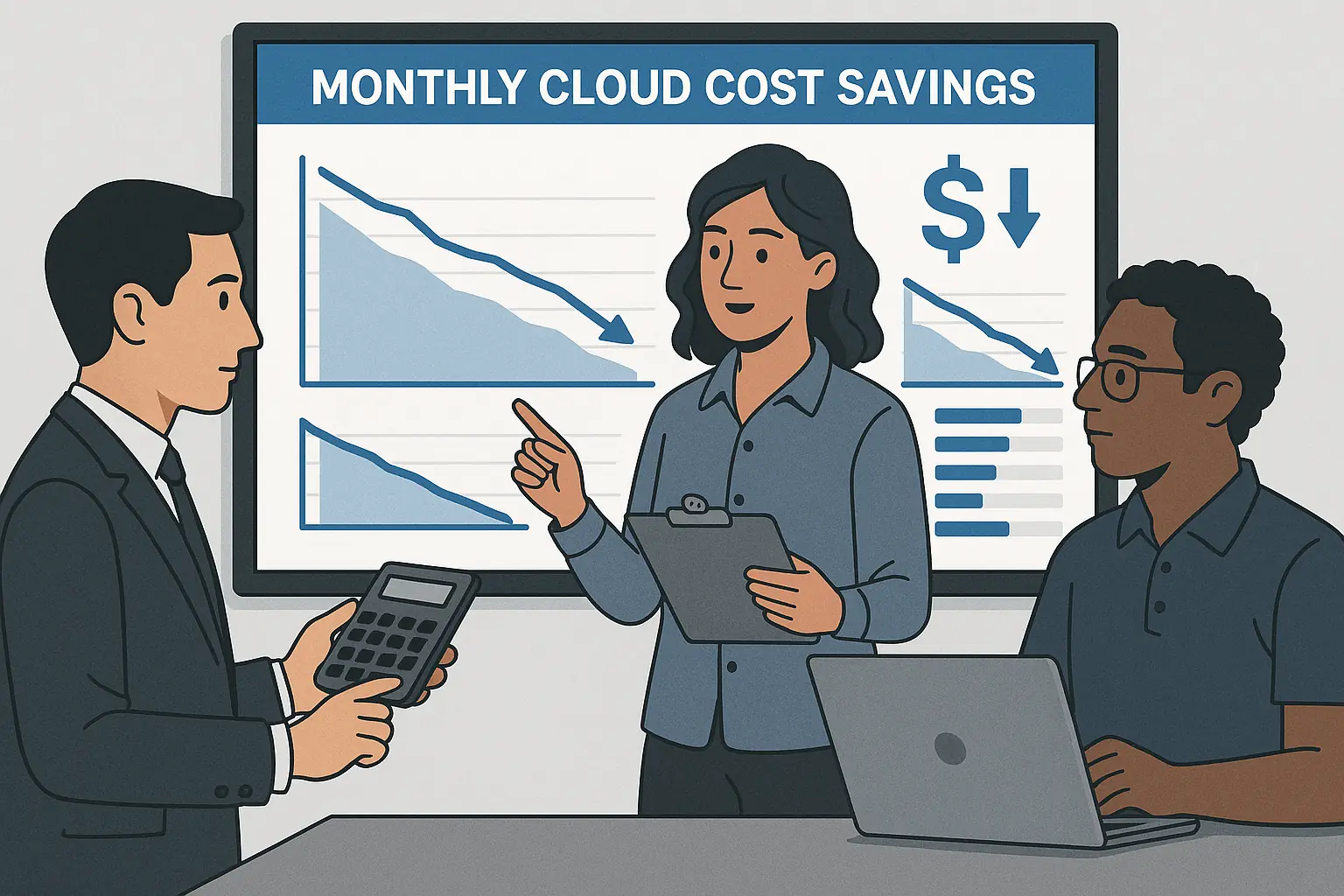
Reducing cloud costs by up to 40% is not a coincidence. It is the result of applying a disciplined, well-structured FinOps methodology. In this FinOps cloud case study scenario, the company’s main challenge was infrastructure costs growing exponentially alongside its user base. By applying a rightsizing strategy, we adjusted compute instance specifications to match the actual workload profile of each application service.
In addition to rightsizing, we also used long-term commitment purchasing options such as Reserved Instances and Savings Plans for workloads that are constant and predictable. Combining the reduction of excess capacity with commitment discounts produced a significant drop in costs from the very first month of implementation. These tactical steps show that cost efficiency does not have to mean limiting business growth. It means getting the most value from every rupiah invested in cloud.
Keeping System Reliability and SLAs Strong
The biggest concern for CTOs when pursuing cost efficiency is the risk of application performance degradation, or even system failure that could damage the company’s reputation. For this reason, we set very strict boundaries around the Service Level Agreements (SLA) and Service Level Objectives (SLO) the system must meet. Every capacity reduction was preceded by comprehensive load testing in a simulated environment to confirm the system could withstand sudden traffic spikes.
This scenario also applied a highly responsive, dynamic autoscaling mechanism. The cloud infrastructure automatically adds compute capacity when traffic is high and scales back down to the minimum level when traffic subsides. As a result, the end-user experience stays at the highest quality, while the company pays for additional infrastructure only when it is truly needed.
Building a Culture of Cost Ownership Within Engineering Teams
The most valuable long-term change from implementing FinOps lies in the cultural transformation within the organization itself. We help companies build a shared awareness in which every engineer feels responsible for the cost of the code they write and release to production. With intuitive cost monitoring dashboards, developers can now see directly how much daily cost a new feature under development generates.
This awareness encourages more efficient coding practices and leaner microservices architectures from the very start of the software development lifecycle. When engineering teams take pride in designing systems that are both resilient and cost-efficient, cloud efficiency becomes an organic part of the company’s DNA. This culture of cost ownership helps ensure that the savings achieved do not creep back up in the future.
Strategic Steps to Start Your FinOps Transformation with Pandawa Cloud .Net
Cross-Divisional Collaboration for Financial Sustainability
To begin this efficiency journey, your company does not need to overhaul a system architecture that is already running well. Drawing on the FinOps cloud case study we have outlined, the most sensible first step is an initial assessment of your current infrastructure. Pandawa Cloud .Net is a strategic partner ready to support your IT and finance teams in mapping potential savings without disrupting day-to-day business operations.
We understand that every company has unique workload characteristics and business needs, so no single solution fits every situation. Through a consultative approach as a Wise Peer, we are committed to helping you design a FinOps roadmap personalized to your company’s scale and financial targets. Together, we can help turn your cloud infrastructure from a cost center into an efficient, sustainable driver of business growth.