 Bayu Permadi
Building Genuine System Reliability for Your Business
For a Head of Engineering or CTO, the pressure to present perfect uptime numbers to customers often leads to risky compromises. Many organizations get caught up in marketing promises without first setting realistic internal SLAs based on the actual capacity of their teams and infrastructure. Committing to high availability without a solid internal foundation is like building a skyscraper on quicksand. When downtime occurs, the impact goes beyond a technical disruption: it erodes customer trust built over years and can bring significant financial penalties. The first step in designing a sustainable reliability strategy, therefore, is to align business expectations with operational reality at the engineering level.
Why the “Nines” Often Become a Reputational Trap
In cloud computing, we often hear the appealing promise of “four nines,” or 99.99% uptime. Behind that number, however, lies a very heavy operational burden, because the cumulative downtime tolerance is only about 52 minutes per year. Failing to understand these operational implications is often the result of limited transparency between product teams, who want to stay competitive in the market, and engineering teams, who manage the real limitations of the system. Without a serious effort to set realistic internal SLAs, an external promise becomes a liability waiting for the wrong moment to surface. We need to look inward and measure reliability metrics honestly before publishing them externally.
The Reality Behind Modern Infrastructure
Today’s highly distributed infrastructure brings new complexity that makes high reliability harder to achieve. Dependence on third-party APIs, intricate microservice networks, and database latency are all variables that often sit outside the full control of your operations team. If you promise an aggressive external SLA without accounting for these external variables, you are designing a failure scenario for your own team. This is why a strategic outlook that prioritizes system resiliency matters more than chasing theoretical numbers on paper.
Why Uptime and User Satisfaction Are Two Sides of the Same Coin
Bridging the gap between marketing promises and technical capability requires a deep understanding of how system reliability directly affects customer retention and a company’s financial health. When a system is disrupted, the real loss is not only the transactions missed in those minutes, but also the team productivity consumed by firefighting instead of product innovation. To build a robust defense strategy, technology decision-makers need to move from simply monitoring raw server availability to monitoring the actual user experience.
Connecting System Reliability to Real Business Metrics
High uptime is not just a technical goal; it is a core pillar that supports customer satisfaction and brand reputation. When we succeed in setting realistic internal SLAs, we give engineering teams room to iterate on the product safely, without a constant fear of system failure. Reliability that is measured internally allows management to make wiser technology investment decisions, such as when to prioritize bug fixes and system stability over releasing new features. This alignment ensures that every rupiah spent on infrastructure contributes directly to long-term customer retention.
The Anatomy of Service Level Objectives (SLOs) and Service Level Indicators (SLIs)
Before moving on to SLAs, which are legal commitments, we first need to master the fundamentals of Service Level Indicators (SLIs) and Service Level Objectives (SLOs). An SLI is a specific metric that measures service performance, such as latency or request success rate, while an SLO is a performance target agreed internally on the basis of that SLI. These concepts are explained in depth in industry guides such as the Google SRE Book, a global reference for managing reliability at scale. By understanding how SLIs, SLOs, and SLAs relate to one another, your organization can avoid subjective debates during incidents and move toward decisions grounded in concrete data.
Balancing Reliability, Cost, and Operational Risk
Every company wants a system that is always on and responsive every second. That desire has to be balanced against the fact that each additional increment of reliability requires exponentially greater investment. Choosing the right level of reliability is an exercise in balancing infrastructure cost, human resource allocation, and business risk tolerance. This is where technology leadership comes in: guiding the organization along the most efficient path that remains resilient in the face of operational uncertainty.
Tactical Steps for Setting Realistic Internal SLAs
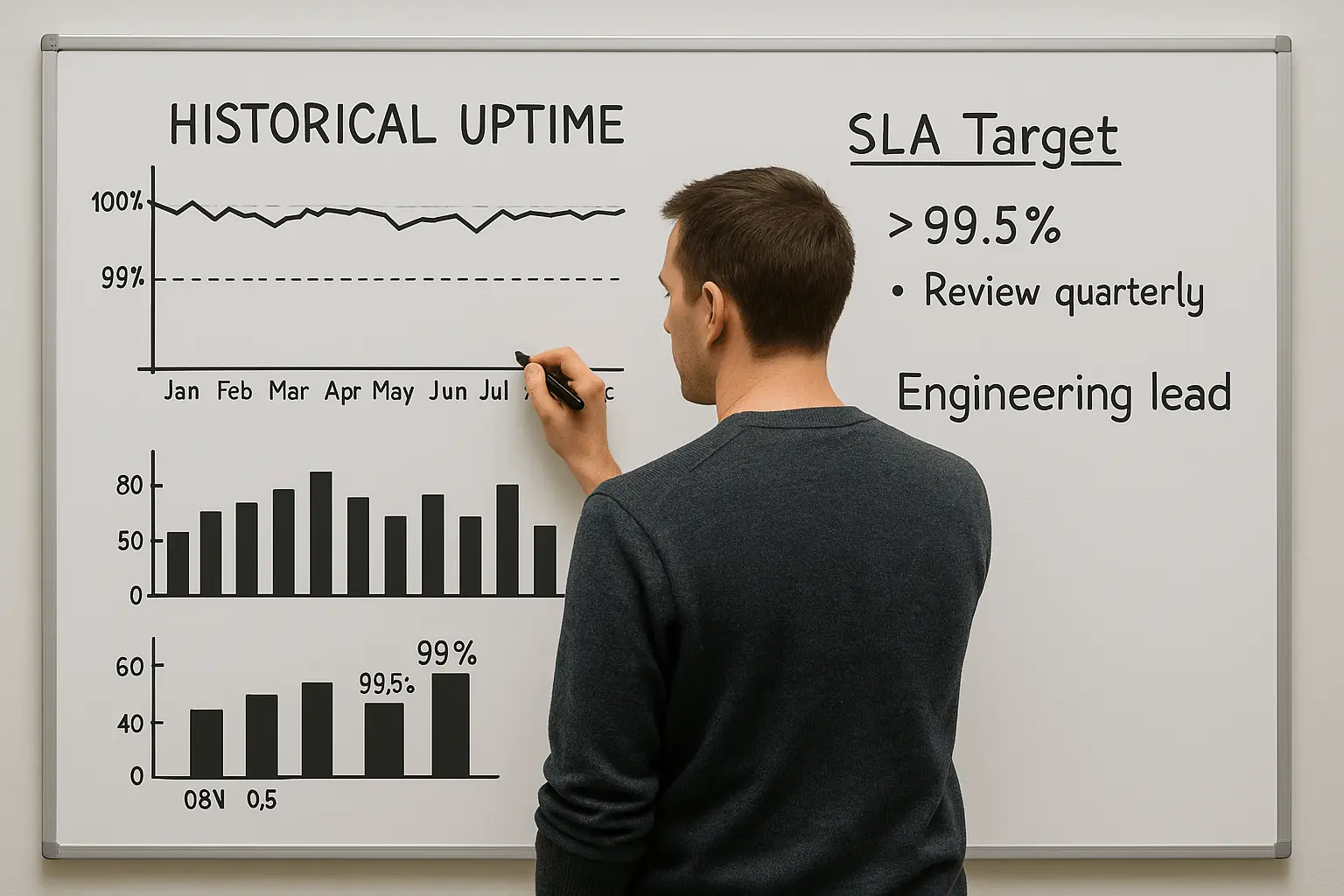
The process of setting realistic internal SLAs begins with a thorough audit of your system’s historical performance over the past six to twelve months. From this data, the team can identify failure patterns, along with the mean time to detect (MTTD) and mean time to recover (MTTR) that actually occur in practice. Next, define what is known as an “Error Budget”: the amount of failure the system can tolerate within a given period before the user experience is significantly affected. If your Error Budget is nearly exhausted, the team should automatically pause new feature releases and focus fully on improving system stability to stay within a safe SLA boundary.
Building a High Availability Architecture Without Draining Your Budget
Achieving high availability does not always mean duplicating your entire infrastructure and multiplying your monthly cloud costs irrationally. A smarter strategy is to identify the critical components of your application that truly need high redundancy, while non-critical components can run on a simpler architecture. With this risk-zoning approach, you can design an efficient Disaster Recovery (DR) strategy in which data recovery is prioritized for the core transaction flows that are most sensitive to downtime. The result is a resilient system with cost efficiency kept in check.
Strategic Collaboration to Secure the Future of Your Infrastructure
Defining and implementing system reliability is not a one-time project. It is a process of continuous refinement that requires deep expertise and the right monitoring tools. For fast-growing companies, managing this complexity alone often diverts valuable focus from developing the core business. Partnering with a cloud infrastructure specialist who understands the nuances of system reliability is one of the best strategic ways to reach your business targets sooner without taking on high operational risk.
Aligning Your Operations Team with Your Business Future
At Pandawa Cloud .Net, we understand that behind every line of code and every running server is a business promise you have made to your customers. Our approach as a strategic advisor is focused on helping you design a cloud architecture that is not only technically reliable, but also sensible financially and operationally. By letting specialists manage the complexity of the infrastructure, your engineering team can return to what matters most: building product innovation that drives business growth.
The First Step Toward Guided, Reliable Infrastructure
Don’t let your business reputation depend on an uptime promise that lacks a strong internal foundation. Starting this journey does not have to be complicated or daunting when you have the right partner beside you to help set realistic internal SLAs. Contact our team of experts at Pandawa Cloud .Net today to discuss how we can help audit your current infrastructure, design a reliability strategy tailored to your business needs, and build a technology foundation ready to support your future growth with confidence.